Traditional holography records the light wave information of an object on a photosensitive material through laser interference, and then reproduces the three-dimensional information of the object by reconstructing the interference pattern. Compared with traditional holography, computational holography does not rely on the optical interference recording of the actual object. Instead, it uses the method of computer digital simulation, and calculates the digital hologram based on the three-dimensional information of the object.
CGH mainly consists of two parts: One is to obtain the complex amplitude scattering or diffraction field by using digital calculation methods based on the digital model of an object or a preset three-dimensional scene; the other is to convert the calculated complex amplitude field into an encoding format suitable for display devices (such as spatial light modulators, SLM), thereby achieving the holographic reproduction of the scene.
CGH has broken through the limitations of traditional holographic recording in terms of physical medium and interference conditions, significantly enhancing the flexibility and controllability of holograms, and becoming an important tool for digital holographic display and optical research.
II. Principles of Calculating Holographic CGH
Diffraction and interference of light waves
The core of computational holography lies in simulating the propagation of light waves of an object or scene and their diffraction and interference processes. Light waves can be described by complex amplitudes, including amplitude and phase information. The propagation simulation can be achieved through theories such as Fresnel diffraction and Fraunhofer diffraction. The essence of CGH in computing its hologram is to calculate the complex amplitude distribution from the object to the hologram plane.
Calculation of the complex amplitude
To generate a CGH, the complex amplitude needs to be obtained, which includes the amplitude and phase information of the light. These information usually come from the three-dimensional model of the object, or are obtained by calculating the propagation of the light field on the projection surface. The basic calculation involves the following steps:
Calculation of the light field distribution on the surface of an object;
Using the diffraction theory, calculate the field propagating from the surface of the object to the observation surface;
Convert the complex amplitude field into a light intensity map or modulation map suitable for display.
III. Main Calculation Methods
Fresnel approximation diffraction method
By applying the Fresnel diffraction principle, approximate calculations can be made for the propagation of light fields on planar or curved surfaces. The computational complexity is moderate, making it suitable for generating holograms at relatively short distances and with medium-sized scales.
Fresnel diffraction method
Fresnel diffraction is an approximate model for far-field diffraction, suitable for calculating holograms with long-distance propagation. Its calculation process is equivalent to Fourier transformation, and it is often accelerated by the Fast Fourier Transform (FFT) algorithm.
Point light source superposition method
The three-dimensional object is decomposed into numerous point light sources, and the wavefronts of each point light source projected onto the holographic surface are calculated. The wavefronts of all points are superimposed to obtain the final complex amplitude map. This method is suitable for complex objects but has a large computational load. It can be accelerated through parallel computing methods such as GPU.
Iterative calculation method
To address the physical limitations of the modulator (such as phase modulation or amplitude modulation), iterative algorithms like Gerchberg-Saxton are employed to optimize the quality of holographic encoding, reduce noise and artifacts, and enhance the quality of the reconstructed image.
IV. Implementation Technology of CGH
Spatial Light Modulator (SLM)
SLM is the key equipment for converting CGH digital information into actual modulated light waves. It includes devices such as liquid crystal on silicon (LCOS) and digital micromirror devices (DMD), which can achieve modulation of phase or amplitude to form reconstructed wavefronts.
Computer hardware support
The generation of CGH involves a huge amount of computation. By leveraging high-performance GPUs, FPGAs and other hardware for parallel computing, the computing speed can be significantly enhanced, enabling real-time or near-real-time calculations.
Display and recording medium
In the CGH system, holograms are displayed through SLM or recorded on optical media through laser exposure to achieve image reproduction. Different media have different effects on resolution, field of view and reconstruction quality.
V. Key Technical Challenges of CGH
Computational speed and real-time performance
The holographic computing for high-resolution and complex scenes involves an enormous amount of data. How to optimize the algorithm structure and utilize hardware acceleration is a significant challenge.
Reduce reconfiguration noise
The high-order interference waves generated during holographic reconstruction cause artifacts, and it is necessary to design an optimized encoding scheme and apply filtering algorithms to reduce noise.
Display device limitations
The current spatial resolution, modulation bit depth and refresh rate of SLMs limit the quality and dynamic effects of holograms.
VI. Application Areas of CGH
Three-dimensional display and virtual reality
Using the CGH technology to generate realistic three-dimensional images, without the need to wear special glasses, it has the advantages of natural parallax and strong spatial realism, and is applied in fields such as VR/AR, exhibition displays, and medical imaging.
High-density optical data storage
CGH can achieve high-density information encoding in three-dimensional space, and when combined with multi-layer storage materials, it can increase storage capacity and access efficiency.
Optical Inspection and Measurement
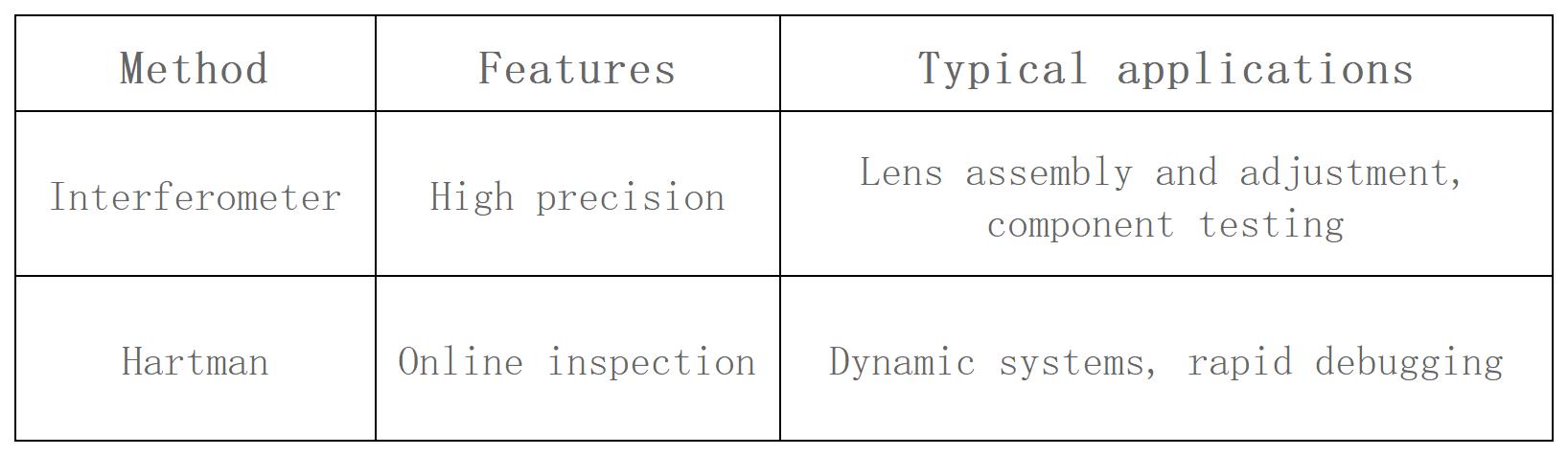
In fields such as interferometric measurement, topography inspection, and stress analysis, the CGH technology offers highly accurate optical measurement methods.
Optical Communication
CGH can be applied to adaptive beam shaping, multimode fiber transmission and optical phased arrays, enabling high-speed and high-capacity optical communication.
Information Security and Encryption
By using CGH for complex optical encoding of information, the security and anti-counterfeiting performance of the information can be enhanced.
VII. Future Development Trends
Real-time dynamic holographic display
Combining high-performance computing and advanced SLM technology, real-time display of dynamic and interactive three-dimensional images is achieved.
Multimodal fusion
Combining CGH with depth cameras and artificial intelligence algorithms can enhance the quality and intelligence level of holographic images.
Ultra-high resolution and wide viewing angle
Promote the development of new materials and micro-nano manufacturing technologies, and create display devices with higher resolution and wider viewing angles to meet the demands of more complex applications.
Photon computing and quantum holography
Explore the integration of photonic computing platforms with quantum optics to achieve novel holographic information processing technologies.
Conclusion
Computational Holographic CGH, as an important branch of digital optical innovation, integrates technologies from multiple disciplines such as optics, computer science, and materials science. It has great potential for achieving high-quality three-dimensional image display and high-precision optical measurement. With continuous improvements in hardware performance and algorithm optimization, the role of CGH technology in scientific research, industrial applications, and consumer electronics will become increasingly prominent, driving the development of the next generation of optical information technology. In the future, by combining artificial intelligence and new optical devices for innovation, computational holography will undoubtedly lead the revolutionary trend of the next generation of visual experiences.
We use cookies to offer you a better browsing experience, analyze site traffic and personalize content. By using this site, you agree to our use of cookies.Privacy Policy