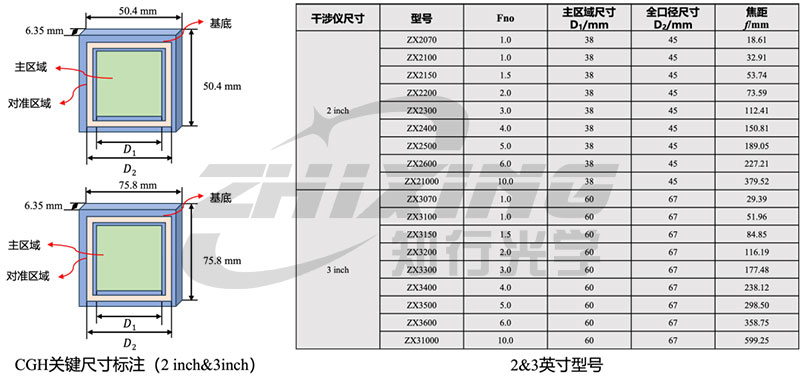
1. The Love and Hate of Off-Axis Three-Mirror Systems: Peak Performance vs. Assembly Abyss The advantages of off-axis three-mirror systems are obvious: they eliminate central occlusion, significantly improve the system's modulation transfer function (MTF), and have excellent aberration correction capabilities. However, for assembly engineers, it is an extremely difficult "opponent" to tame:
◆ A Nightmare of Degrees of Freedom: A typical off-axis three-mirror system (primary mirror, secondary mirror, and tertiary mirror) has up to 18 spatial degrees of freedom. Even slight eccentricity, tilt, or axial spacing of each element can couple and produce complex superimposed aberrations.
◆ Complex Reference Transfer: Traditional assembly relies heavily on the transfer of multi-level mechanical references. From the primary mirror to the secondary mirror, and then from the secondary mirror to the tertiary mirror, each step of the transition introduces accumulated errors from machining and repetitive positioning, making the assembly process feel like a "blind search."
◆ Extreme Dependence on Experience and Time: In the past, the convergence of a high-performance payload often required senior engineers to spend weeks or even months repeatedly studying and debugging. In today's commercial space industry, which demands "rapid delivery and mass production," this model is no longer sustainable.
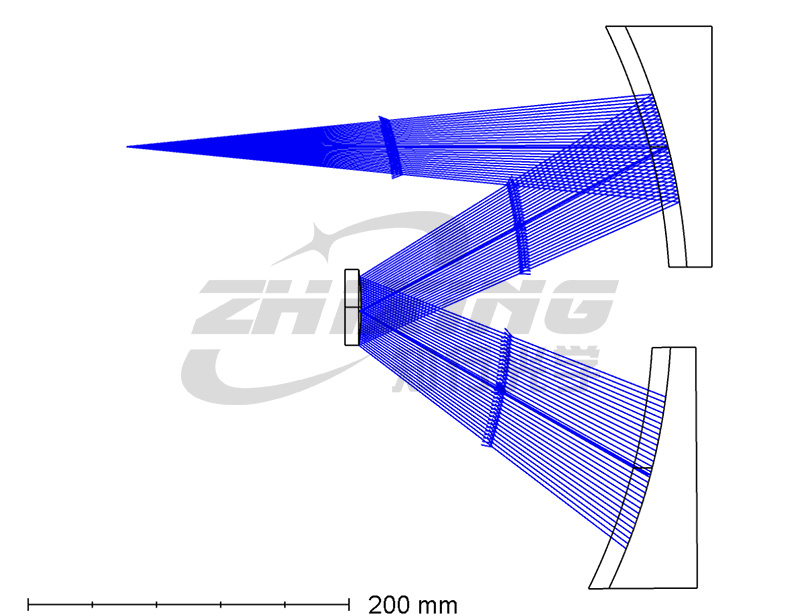
Off-axis three-reflector path diagram
2. Zhixing Solution: Achieving "Dimensional Reduction" in Assembly and Adjustment by Sharing a Common Reference CGH for the Primary and Secondary Mirrors. To eliminate the reliance on complex reference transfer in traditional assembly and adjustment, Zhixing Optics proposes a more modern engineering approach: digitally locking the relative poses of the primary and secondary mirrors at the manufacturing stage using a CGH (Computational Hologram). We directly design the compensation phases of the primary mirror (PM) and the secondary mirrors (TM) on the same CGH substrate, achieving integrated references for both mirrors through semiconductor-grade photolithography.
◆ Logic Transformation from 18 Dimensions to 6 Dimensions: Originally, the primary, secondary, and TM mirrors each had 6 degrees of freedom, totaling 18. After locking the relative geometric relationship between the primary and TM mirrors using a high-precision CGH, these 12 degrees of freedom are "zeroed out" on the optical reference. For the overall assembly, the originally complex system-wide search is simplified to only adjusting the secondary mirror position and the overall system alignment of 6 degrees of freedom.
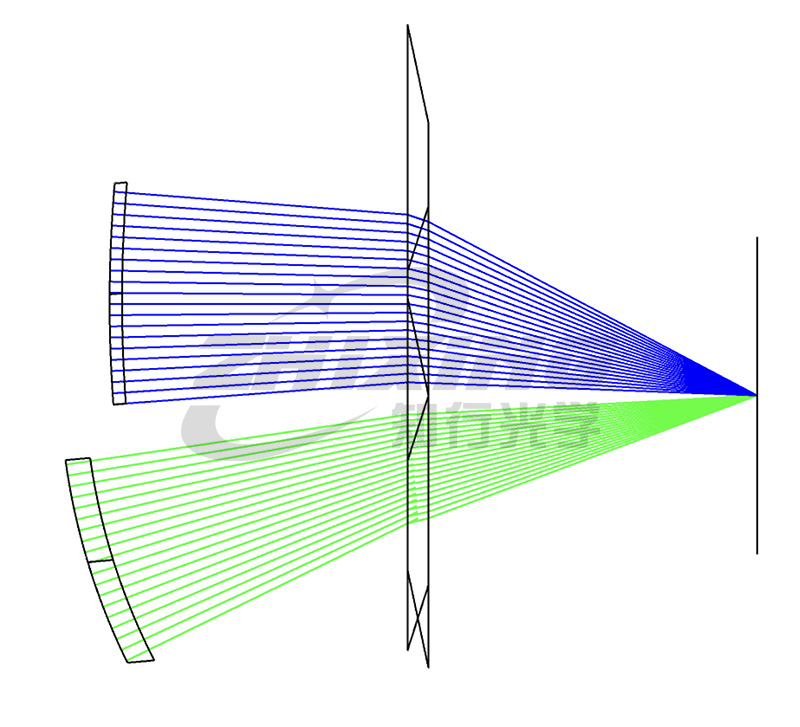
Off-axis three-mirror CGH optical path diagram
◆ Semiconductor process ensures absolute precision: With the help of advanced photolithography equipment, the etching precision of the CGH surface pattern can reach the sub-micron level. This means that the relative positional accuracy between the three main mirrors is determined during the CGH processing stage, and its stability and precision far exceed those of mechanical tooling and manual measurement.
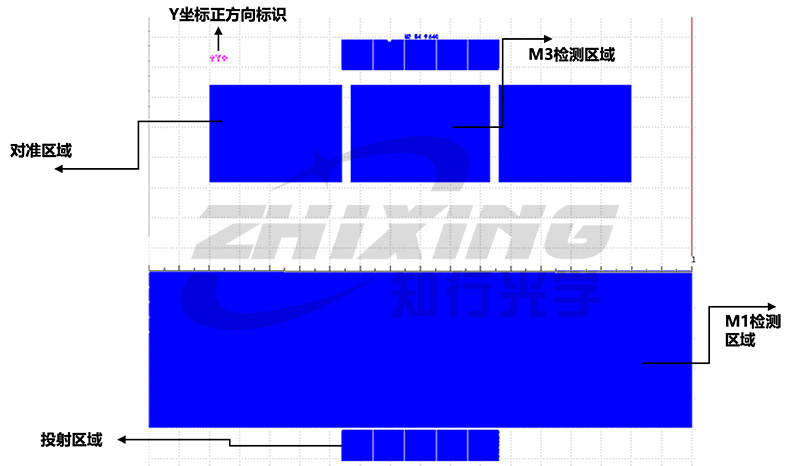
Schematic diagram of the overall layout of the off-axis three-reverse mounting CGH
◆ Dimensional Reduction from "Complex Assembly and Adjustment" to "Surface Shape Detection": In this mode, the assembly and adjustment work is simplified to: as long as the surface shape fringes of the primary mirror and the three mirrors are adjusted simultaneously, their relative spatial poses automatically reach the theoretical design value. The complex assembly and adjustment process is directly "reduced" to the difficulty of surface shape detection of two mirrors.
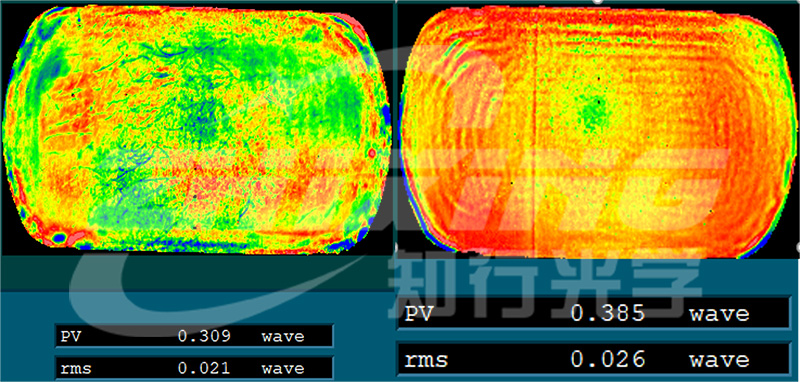
The setup and adjustment results of the three main lenses (left: main lens, right: three lenses).
3. Why Does Commercial Spaceflight Need This "Certainty"? In today's industry, where "mass production" and "fast pace" are key words, efficiency is the core competitive advantage:
◆ Eliminating reliance on personal experience: Digital benchmarks standardize the assembly and adjustment process. As long as an ordinary engineer can read interference fringes and use CGH, they can efficiently complete high-difficulty alignments that previously required top experts.
◆ Rapidly shortened project cycles: Reducing interference by 12 degrees of freedom means eliminating most error coupling. The assembly and adjustment process changes from "disordered search" to "directional convergence," shortening the overall assembly cycle from weeks to days.
◆ Adapting to batch production consistency: Every satellite payload uses the same set of digital coordinate "master templates," ensuring a high degree of consistency in payload performance. This is the solid technological foundation for large-scale constellation networking in commercial spaceflight. Conclusion: In the competitive arena of commercial spaceflight, what we need is no longer the meticulous craftsmanship of "artworks," but the precision and efficiency of "industrial products." Zhixing Optics, through its common benchmark CGH technology, lowers the barrier to precision optical assembly and adjustment, accelerating your project delivery with digital benchmarks. Zhixing Optics helps complex optical systems achieve efficient closed-loop operation.