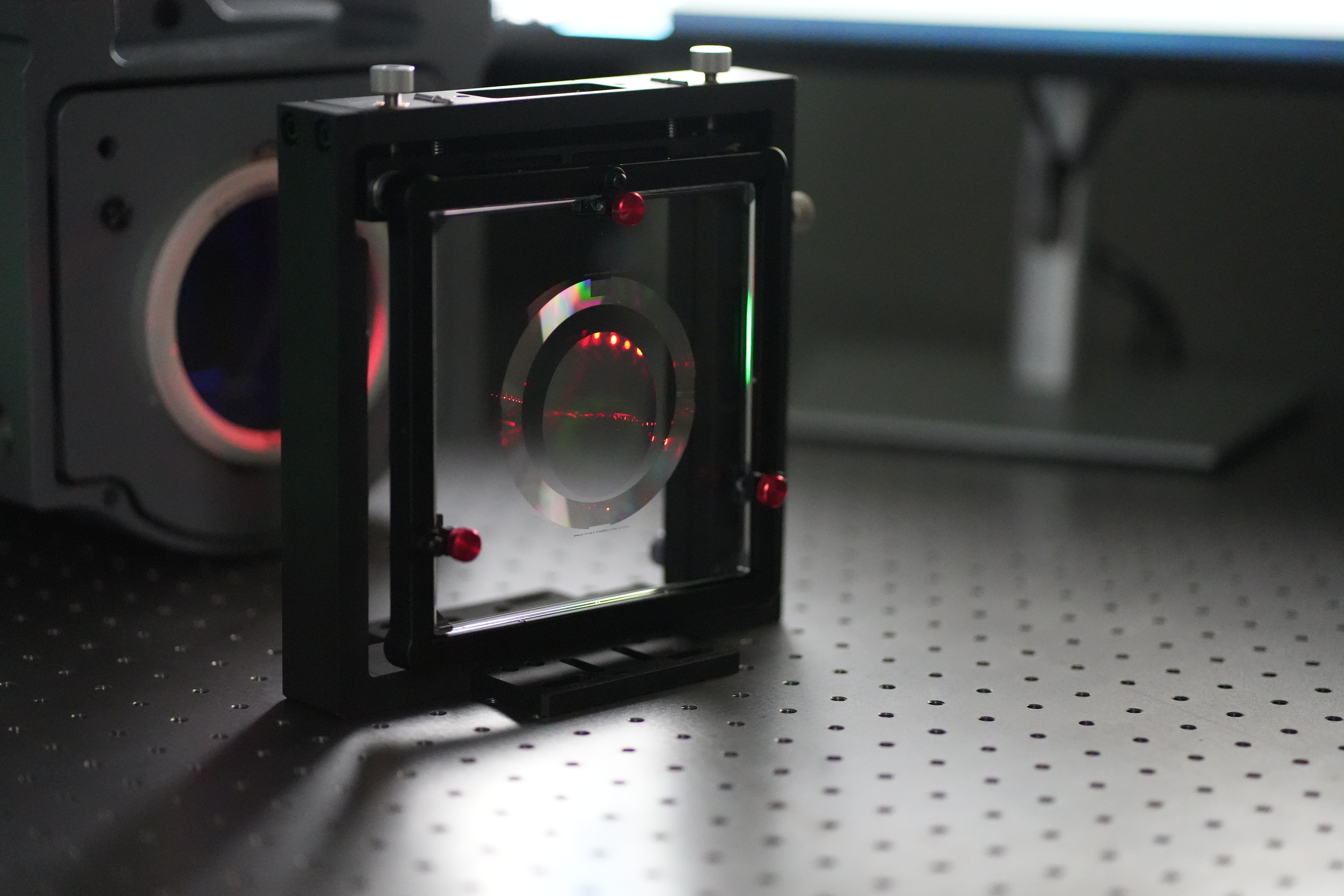
The "Multitasking Dilemma" of CGH: Why Does Stray Light Exist? To understand "carrier frequency," we must first understand a premise: CGH itself is a diffractive optical element. When you shine a beam of light on a CGH, it won't simply produce the desired diffraction order. Due to the fundamental laws of physical optics, it will simultaneously produce several "clones": the +1 order (target signal) you need, the 0th order that passes straight through without diffraction, the -1 order that deflects to the other side, and even higher orders...

Figure 1. Light of different diffraction orders (blue represents +1st order, the rest are stray light).
In an ideal design, only the +1 order light carries information about the measured surface back to the interferometer. However, in reality, the 0th and -1st order "parasitic" orders also wander aimlessly in the optical path. Once they enter the measurement optical path, they create stray light interference. The result is decreased contrast in the interference fringes, blurred edges, and sometimes even the superposition of false phase information. In short, blurred fringes are often not due to weak light, but rather to excessive noise. What is a "carrier frequency"? The introduction of a carrier frequency is to resolve this "signal and noise" conflict. We can imagine the phase distribution of the CGH as a coded diagram recording the "shape information of the measured surface." The "carrier frequency" is an additional tilt or defocus factor superimposed on this coded information. This operation sounds abstract, but its purpose is very pure—to give the useful target signal a "new room" in the spatial frequency domain. Originally, the target signal and those useless 0th and -1st order stray lights are crowded together and entangled in the frequency spectrum. No matter how you block it spatially, you can't completely block it. But once a carrier frequency is superimposed on the target signal, its spectrum is "shifted" to a higher frequency range, thus creating distance from the stationary interference signals. This is like being at a noisy party where you and your friends are initially drowning out the noise and can't hear each other. But the carrier frequency is like giving you and your friends a specific high-frequency tone; you two shift to this tone that no one else is using to communicate, and the surrounding low-frequency noise instantly becomes a filterable background.

Figure 2. Order separation by tilted carrier frequency

Figure 3. Separation of levels by defocus carrier frequency
Once the interfering and target signals are separated in the spectrum, subsequent spatial filtering can cleanly and effectively "keep stray light out." The art of filtering: not the stronger the better, but just right. This is an art of balance, about finding the "just right" moment. If the carrier frequency is too low—the spectra of the interfering and target signals still overlap, creating a tangled mess, resulting in filtering failure and blurred fringes. If the carrier frequency is too high—the spectrum is sufficiently separated, but this leads to extremely narrow linewidths in the CGH, placing extremely stringent demands on micro-nano fabrication precision. This not only means a surge in manufacturing difficulty but also a severe impact on the diffraction efficiency of the actual CGH. In an ideal design, most of the energy is concentrated in the +1 order, but if the carrier frequency is too high, even a slight deviation in the manufacturing process can cause light to leak into other orders, significantly reducing the signal intensity. Where does true design skill lie? In finding that "minimum effective carrier frequency." A good design isn't about randomly pulling out values in drawing software; it's about precisely calculating how to minimize the superimposed carrier frequency while ensuring clean separation of all interfering diffraction orders. Achieving clean separation with a small carrier frequency guarantees both fringe contrast and sharpness without placing excessive pressure on subsequent manufacturing and processes. A practical suggestion for CGH users: As a CGH user, you don't need to solve those complex carrier frequency equations yourself, but that doesn't mean you can't control the detection results at the source. If your CGH frequently exhibits blurred fringes, poor contrast, or regular background noise during testing, after ruling out optical path and environmental issues, you can request a quantitative analysis report of diffraction order separation from the CGH designer or supplier. This report will clearly tell you: under the current carrier frequency design, where are each interfering order moved to, what is their spectral spacing from the target signal, and whether they can be effectively blocked by the spatial filter. With this report, you can determine whether the CGH's "filtering" design is reliable. Finally, in the pursuit of nanometer-level precision in interferometry, the difference between "seeing clearly" and "not seeing clearly" often lies in a tiny bit of design ingenuity. The carrier frequency plays a role similar to the unassuming lighting technician in the grand spectacle of precision testing—it doesn't determine the content of the image, but it determines how clean the image is. Next time you see a standard interferogram with sharp outlines and a completely black background, remember that it's not just a victory for surface accuracy, but also a beautiful art of frequency filtering.