01 What is the USAF 1951 Resolution Plate?
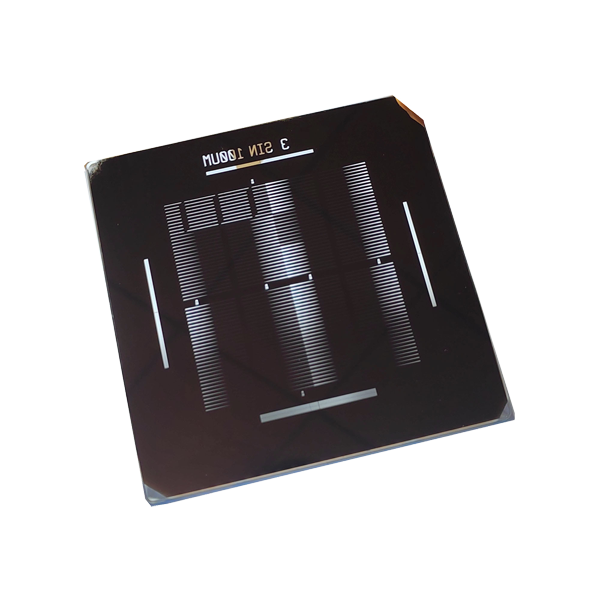
USAF 1951 (United States Air Force 1951 Resolution Target) is one of the most widely used standard resolution test targets in the world. It consists of a standard arrangement of black and white stripes and is used to judge the smallest details that an optical system can resolve. To put it simply: how many lines a lens can clearly separate represents its resolving power.
Common applications include:
◆Lens R&D verification
◆Industrial vision testing
◆Microsystem evaluation
◆Optical system acceptance
02 What are the Group and Element on the resolution board?
The pattern of USAF 1951 consists of multiple Groups and Elements. Each Group contains 6 Elements, each Element corresponds to a different spatial frequency (lp/mm).
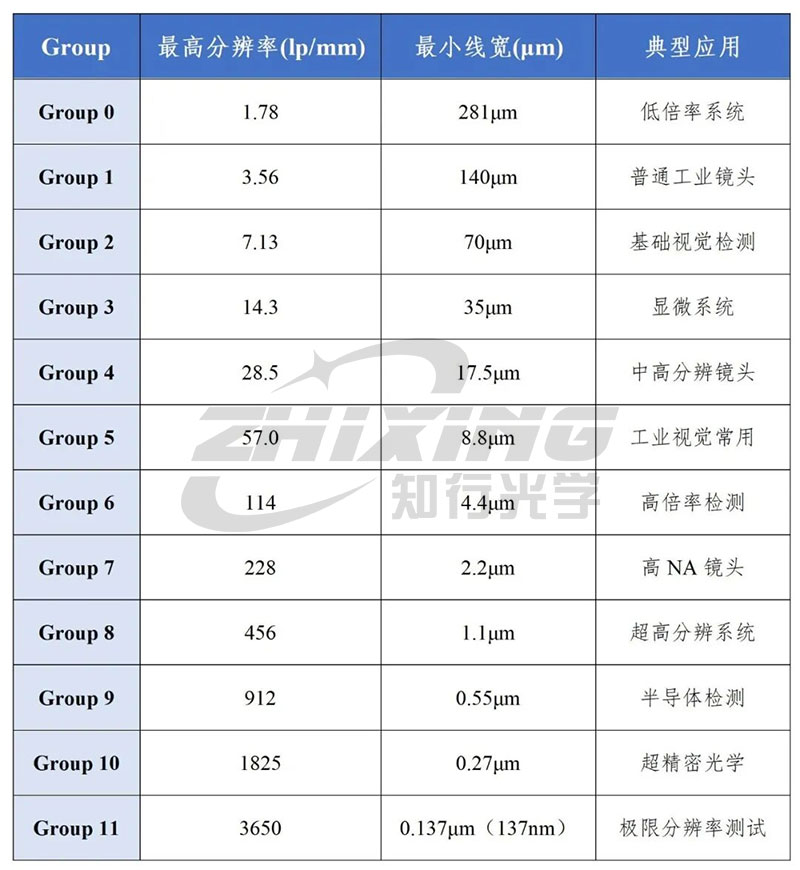
The larger the number: the finer the lines, and the more difficult the test.
03 How to correctly use USAF 1951?
Step 1: Set up the test system
This typically includes:
◆Light source (uniform illumination)
◆USAF resolution board
◆Lens under test
◆CCD/CMOS camera
◆Display and analysis software
Basic test path:
Light source → USAF resolution board → Lens under test → Sensor → Image analysis
Notes:
◆Ensure uniform illumination
◆Accurate focus
◆Align the optical axis as closely as possible
◆Avoid system vibration
Step 2: Find the clearest imaging position
Adjust the focal length or working distance to achieve optimal image clarity.
This is the most crucial step affecting the results.
Step 3: Observe "Can they still be separated?"
Examine the image:
Which group, which element's black and white stripes can still be clearly separated?
Judgment Criteria:
Clearly distinguishable black and white stripes
Stripes blended, grayed out, or indistinguishable
The last recognizable pattern represents the upper limit of the system's resolution.
04 How to convert to lp/mm?
Each Group/Element corresponds to a fixed spatial frequency. Conversion formula:

For example:
◆Group 5, Element 3
◆Corresponds to approximately 20 lp/mm
lp/mm (line pairs/mm) = Number of black and white lines that can be distinguished per millimeter
Minimum line width = Width of a single black or white line
Relationship between the two:

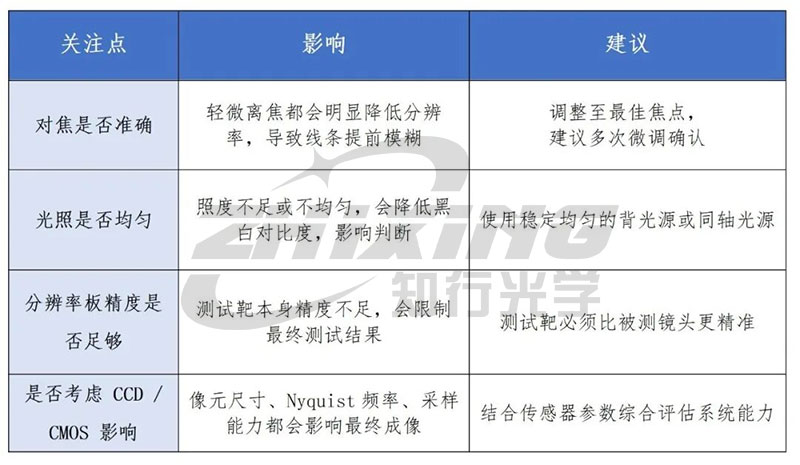
05 How to determine the reliability of test results?
Often, inaccurate tests are not due to lens issues, but rather to problems with the testing methodology.
Recommended reading:
06 When are higher resolution groups needed?
As the resolution of high-end lenses continues to improve, traditional Group 5 and Group 6 are no longer sufficient.
For example:
◆Semiconductor inspection lenses
◆High-NA microscope objectives
◆AOI systems
◆Ultra-high pixel industrial vision
Often, Group 9 / Group 10 / Group 11 are needed to truly measure the system's capabilities.
Especially: USAF Group 11 (up to approximately 3500 lp/mm)
has become an important standard for testing ultra-high resolution lenses.
Conclusion
The USAF 1951 resolution chart is classic because it is simple, intuitive, and reliable.
It not only helps determine whether a lens "sees clearly," but also helps engineers quickly discover exactly how "clearly" the system can see. Choosing the appropriate resolution chart and employing the correct testing methods are essential to obtaining truly reliable test results.