I. Plane & Spherical Surface Inspection: The Cornerstone of Precision Optics
Plane and spherical surface inspection are the "stabilizing force" of optical systems, with the core requirements being ultimate absolute accuracy and disturbance resistance.
1. Direct Wavefront Inspection (Interferometry)
● Fizeau Interferometer:
○ Principle: Common-path interference, the standard mirror and the mirror under test share the same optical path.
○ Advantages: Extremely high accuracy. Due to the high overlap between the reference and measurement light paths, residual aberrations in the system can be naturally canceled.
○ Limitations: Traditional phase-shifting interferometry is extremely sensitive to vibration, requiring stringent vibration isolation and temperature control.
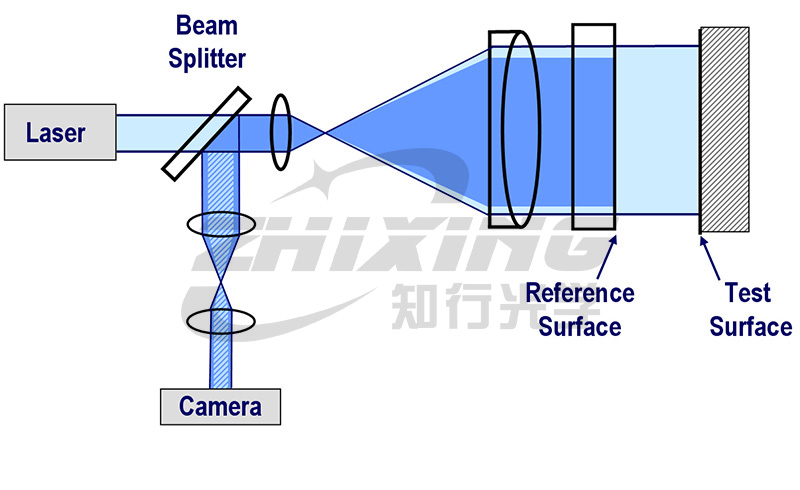
Fizeau interferometer optical path diagram
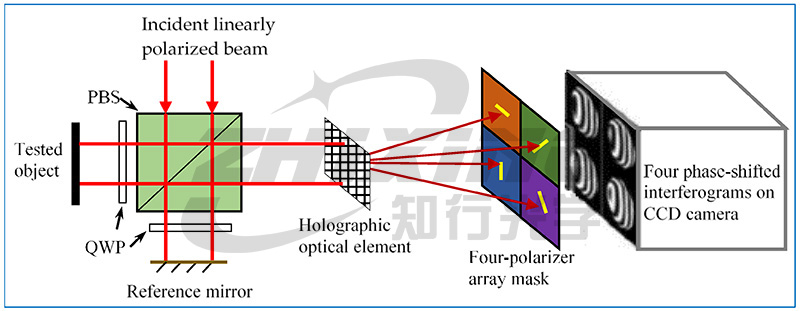
●Dynamic Interferometer (Seismic Resistant Type):
○Principle: Spatial phase shift is achieved within a single frame using a polarizer array, simultaneously acquiring multiple phase difference images to realize instantaneous seismic resistance measurement.
○Advantages: Instantaneous seismic resistance, a lifesaver for online monitoring in vacuum chambers, high and low temperature environments, and noisy factory buildings.
○Disadvantages: Non-common optical path error. The reference light and measurement light paths are separated, and system drift cannot be canceled; furthermore, due to frame-based imaging, its lateral resolution is only 1/4 that of traditional interferometers, making it difficult to capture high-frequency intermediate errors.
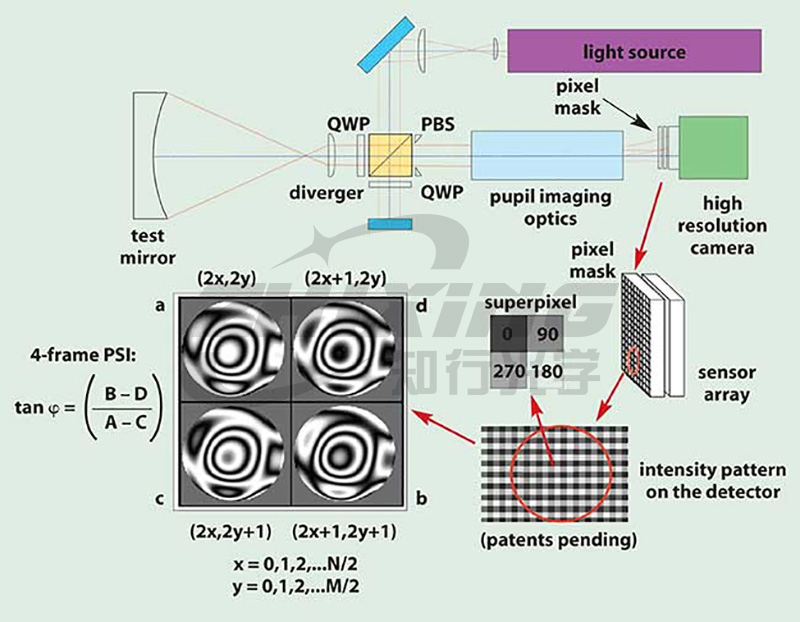
Working principle of dynamic interferometer
2. Slope Detection (Differential Method)
● Shack-Hartmann:
○ Principle: Wavefront is segmented and imaged using a microlens array. The wavefront slope is calculated using the offset of the light spot relative to a reference position, thereby reconstructing the surface shape.
○ Advantages: Extremely large dynamic range, no need for a coherent light source, compact structure.
○ Limitations: Spatial resolution is limited by the microlens aperture density, and absolute accuracy is relatively low (approximately 1/50 lambda).
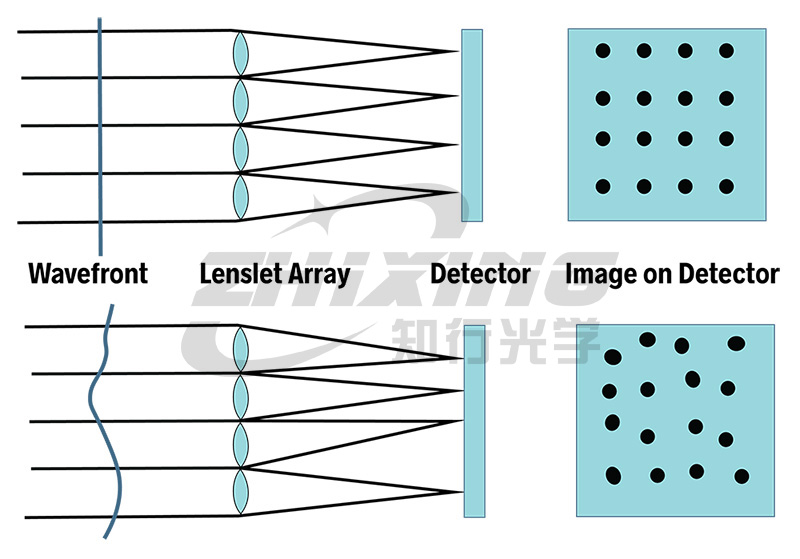
Hartmann Working Principle
● Lateral Shear Interference (LSI):
○ Principle: Wavefront misalignment interference to obtain differential (slope) information of the wavefront.
○ Advantages: No reference light required, possesses common-path properties, and has excellent vibration resistance. Commonly used for on-site wavefront calibration of extremely short wavelengths (such as EUV) or highly integrated systems.
○ Limitations: As a differential measurement, wavefront reconstruction is highly dependent on the integration algorithm, and accuracy is limited by the magnitude of the shearing amount. It is typically used as a system-level calibration solution.
Working principle of transverse shearing interferometer
II. Aspherical Surface Testing: From Geometric Compensation to Diffraction Techniques
The essence of aspherical surface testing is "simplification," transforming complex aspherical wavefronts into easily measurable spheres or planes through compensation methods.
1. Direct Wavefront Testing (Null-Point Compensation Interference)
● Null Point Testing:
○ Advantages: Geometric optics self-collimation, simple optical path, low cost.
○ Limitations: Poor generalization; limited to quadratic surfaces; cannot handle higher-order aspherical or freeform surfaces.
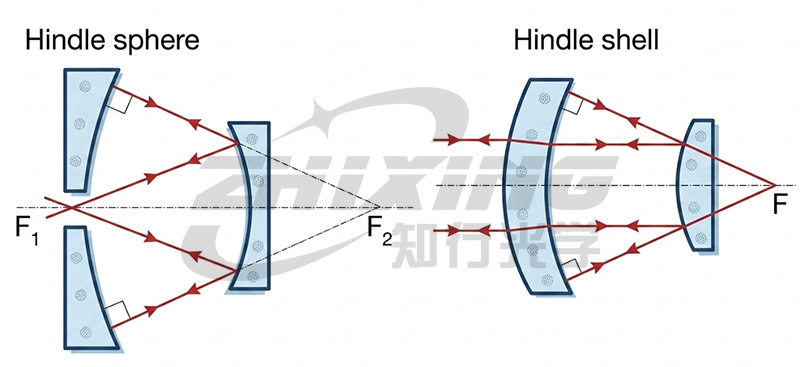
Working principle of image-free detection
● Refractive compensators (such as Offner compensators):
○ Advantages: Mature technology, suitable for large-diameter, conventional aspherical surfaces.
○ Limitations: Extremely complex manufacturing process and sensitive assembly/adjustment. Off-axis deviation must be strictly controlled; even minute assembly errors can introduce severe coaxial aberrations, interfering with surface shape determination.
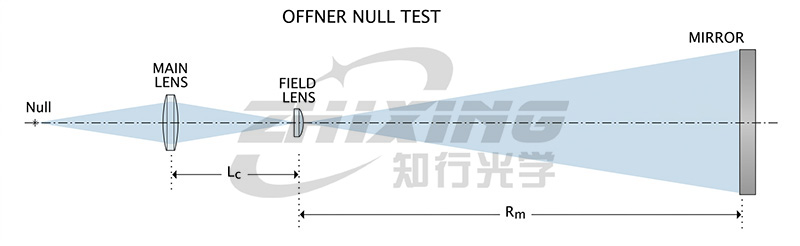
Working principle of refraction compensator
● Computational Holography (CGH):
○ Advantages: Universal compensation. It can integrate alignment features, transforming tedious on-site physical alignment into software-assisted geometric alignment, effectively avoiding the "assembly and adjustment traps" of traditional compensators.
○ Limitations: Lack of versatility. It has a "dedicated" attribute; each aspherical surface requires independent design and customization costs.
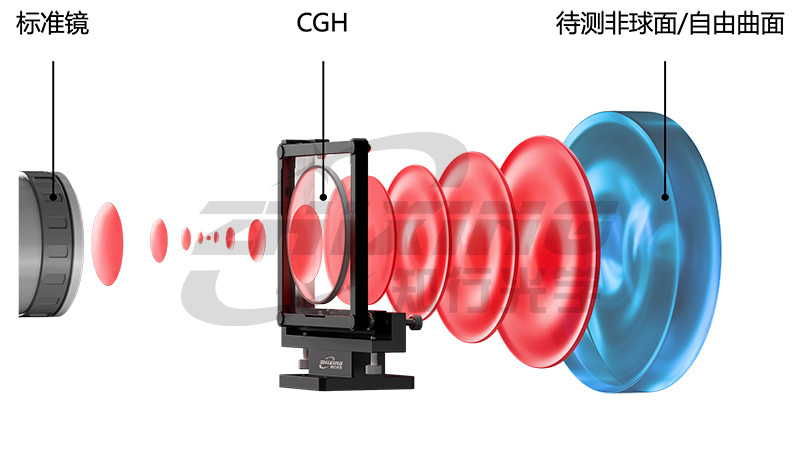
CGH Working Principle
2. Other Detection Schemes
● Sub-Aperture Stitching (SSI):
○ Principle: Interferometers are used to measure local areas with small slope changes, and then mathematical stitching is performed.
○ Advantages: Utilizing a small-aperture interferometer and algorithmic synthesis, this overcomes sensor size limitations, achieving high-resolution detection of ultra-large aperture, large asphericity components, balancing measurement accuracy and system flexibility.
○ Limitations: Controlling cumulative error is difficult; extremely high dependence on a precision displacement stage.
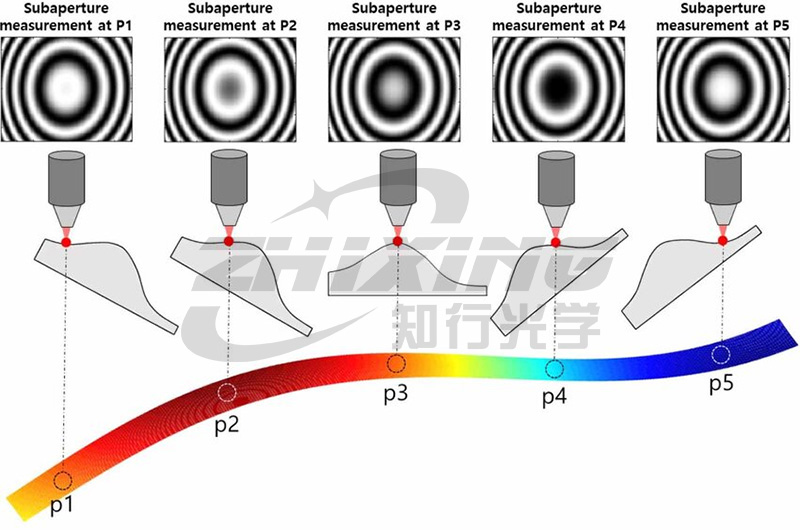
Sub-aperture splicing working principle
III. Comprehensive Comparison: Selection Logic Matrix
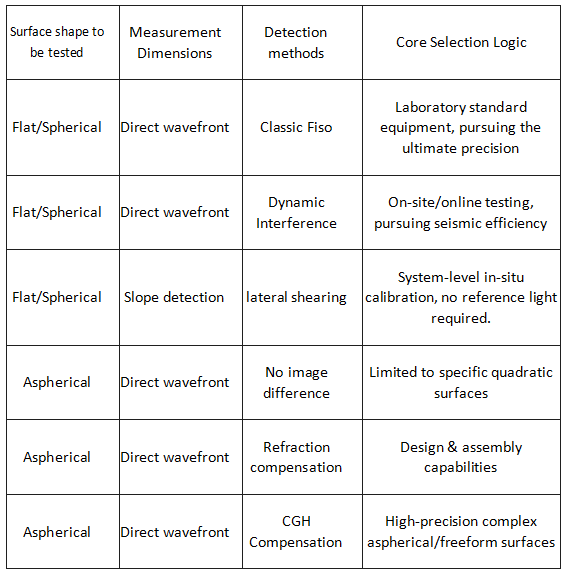
IV. Conclusion: The Balance in Engineering Logic
The selection of precision optical inspection methods is essentially a balancing act between accuracy, efficiency, and cost.
●Accuracy is the bottom line: Under existing environmental conditions, ensure that the inspection error is sufficient to support processing convergence, preventing system failure due to "insufficient quality."
●Efficiency is life: Within existing processing capabilities, choose the method with the fastest feedback and simplest assembly and adjustment, preventing R&D stagnation due to "process redundancy."
●Cost is the boundary: Within a limited budget period, choose the path with the highest overall return on investment, preventing resource waste due to "excessive quality."
Only the "inspection benchmark" established within these three red lines can drive efficient iteration of the processing closed loop. Returning to engineering common sense and starting from the needs is the key to achieving twice the result with half the effort.
About Zhixing Optics
Ningbo Zhixing Optics Technology Co., Ltd. focuses on high-precision computational holography (CGH) inspection solutions, dedicated to solving the core pain points in the measurement of aspherical and freeform surfaces.