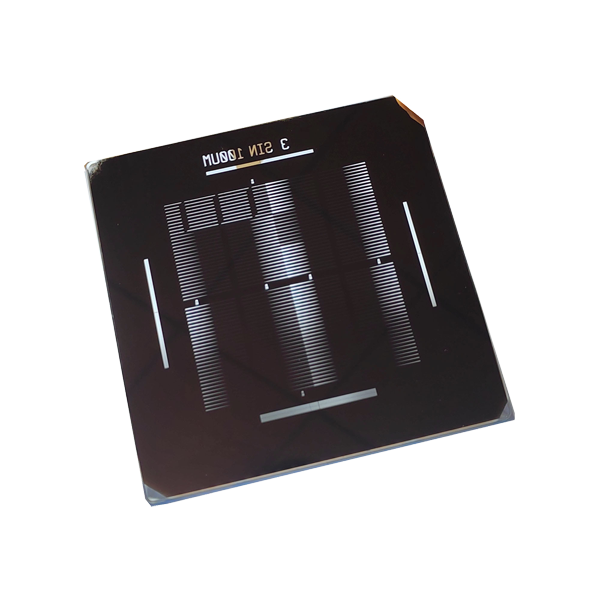
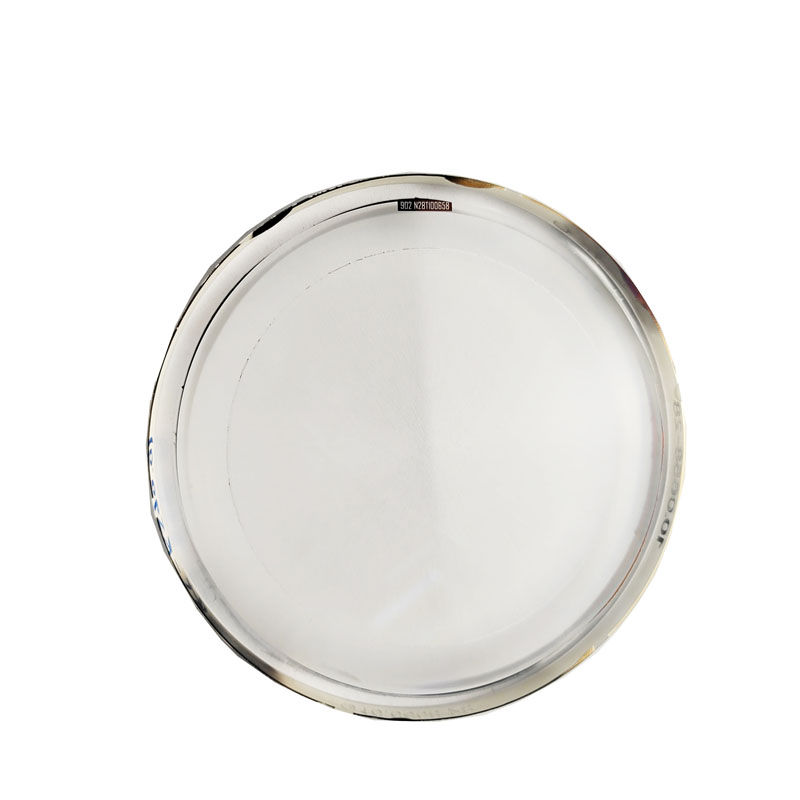
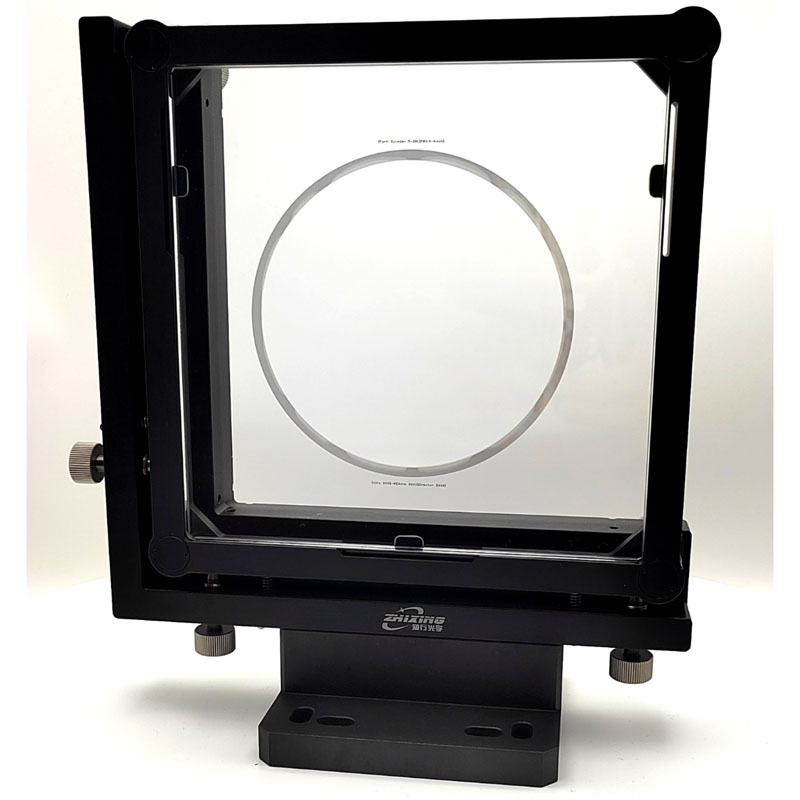
Hidden Killer #1: Reference Transfer Distortion – Strictly Prevent “Illegal Pose” Measurements in the Alignment Area. In the engineering logic of CGH testing, the reference transfer link is extremely rigorous: interferometer wavefront → transferred to the CGH diffraction surface → finally transferred to the lens under test. This is an interconnected geometric chain. In after-sales support, we frequently find that in the measurement data submitted by customers, the CGH alignment area is filled with dense interference fringes. This state means that the CGH is not in the physical pose required by the design; the reference is already misaligned from the first step (interferometer to CGH). Any surface data measured under this “illegal pose” is not only completely inaccurate but also seriously misleading for subsequent problem analysis, representing a highly unrigorous engineering practice.

Diagram of alignment misalignment
Countermeasures: Forced reference locking and returning to "zero-fringe" operating procedures. To ensure the authenticity and validity of measurement data, a "pose-priority" operational mindset must be established: The alignment area is a "command": The alignment area on the CGH is the unique feedback pattern ensuring the spatial relationship between the interferometer and the CGH. The fringes in this area must be adjusted to a "zero-fringe" state or as sparse as possible by fine-tuning the CGH pose. Strictly adhere to the instruction manual's pose: Operators must strictly follow the initial pose defined in the instruction manual during setup and adjustment. Numerous fringes in the alignment area indicate that the CGH's pitch, azimuth, or center offset has not yet reached zero; data acquisition is absolutely prohibited under these conditions. Ensure the uniqueness of the physical reference: Only when the fringes in the alignment area are reduced to the sparsest state under physical limits can it be proven that the CGH is in its designed standard measurement state. The data recorded at this time truly reflects the wavefront deviation caused by the lens under test.
Hidden Killer Two: Mirror "Force Deformation"—The Neglected Source of Astigmatism. If the alignment problem is operational, then this problem directly points to the object being tested itself. Many aspherical mirrors, in order to achieve lightweighting or meet specific optical design requirements, often have a large aspect ratio or are made of materials with relatively limited rigidity. When these mirrors are held in tooling or placed using specific support methods, gravity and clamping stress directly cause deformation on the mirror body. What is the result? Astigmatism. And this astigmatism is real and physically present—the mirror is indeed "pressed" into astigmatism. CGH (Calibrated High-Gross Mirror) detects it with high sensitivity, but the problem is not with the CGH, nor with the mirror's surface finish, but with "how you fixed this mirror." Many instances of astigmatism that are "impossible to adjust" on-site are actually caused by incorrect support methods. Solution: Two steps to pinpoint the culprit. First, focus on the rigidity matching of the mirror and tooling system. For mirrors with a large aspect ratio, the design and verification of the testing tooling must be given equal importance to the mirror manufacturing itself. If you repeatedly measure regular astigmatism, first check the tooling and support methods. Second, use a simple yet extremely effective diagnostic method to confirm the root cause—the rotating CGH test method. Keeping the mirror and fixture in the same position, rotate the CGH by a certain angle (e.g., 90°). If the astigmatism direction in the interferogram remains unchanged, the CGH itself is not the problem; the astigmatism originates from the mirror or fixture, so continue checking the clamping method. If the astigmatism direction rotates synchronously with the CGH, the problem lies with the CGH itself. This test takes only a few minutes but can instantly eliminate suspicion of the CGH, focusing the investigation on the real source of the problem, making it a powerful tool for on-site diagnosis.

The direction of astigmatism remains unchanged after rotating CGH by 0° and 90°.
Hidden Killer #3: The Mirror Under Test Wasn't Clean – Even the best testing equipment is susceptible to contamination. This problem sounds simple, but the chances of getting caught are extremely high, and even more experienced engineers are sometimes more prone to making this mistake. During processing, handling, and clamping, mirror surfaces inevitably accumulate fingerprints, grease, polishing fluid residue, dust particles, and even condensed volatiles from the air. These substances are invisible to the naked eye under fluorescent light, but once they enter the CGH testing optical path, they will appear on the interferogram as localized surface "pits" or "bulges," or small-scale irregular noise. Solution: Establish standardized cleaning and verification procedures. Don't use "almost clean" as a judgment standard. For mirrors before precise testing, define clear solvent selection (e.g., analytical grade ethanol, acetone), wiping methods (dragging, rolling), and final confirmation steps. If possible, quickly scan different areas of the mirror surface under the testing optical path. If a localized "defect" disappears or moves after wiping, it's not a surface shape issue. Thoroughly performing this step can save a significant amount of time spent on unnecessary polishing. Hidden Killer Four: Diffraction Order Crosstalk – Those “Unwanted Light” A CGH is essentially a diffractive optical element that generates multiple diffraction orders. The +1 order is used for detection, while the 0th, -1st, and even higher orders, if not isolated, will stray into the measurement optical path, reducing the contrast of interference fringes and even introducing false phase information. This is essentially a design-level problem, but in the field it often manifests as “blurred fringes,” “poor contrast,” and “errors.” The value of a well-designed carrier frequency lies in cleanly separating interfering diffraction orders. Solution: If you have ruled out other factors and the fringes are still “blurred,” you can confirm the carrier frequency design scheme and the quantitative analysis report on diffraction order separation with the CGH designer. Hidden Killer Five: Insufficient Thermal Equilibrium – Inaccurate Measurements with Newly Arrived Mirrors This problem sounds simple, but it occurs very frequently. Mirrors are taken directly from the processing workshop, cleaning tank, or storage cabinet, and their temperature has not yet fully equilibrated with the testing environment before being placed on the fixture for testing. A temperature gradient exists inside the mirror, and surface thermal deformation causes continuous drift in measurement results—the data measured in the first five minutes differs from those measured ten minutes later; the interference fringes immediately after startup and after stabilization are almost identical. Sometimes, operators find the data incorrect and fiddle with various adjustments, but the mirror is actually "moving on its own"—it's slowly approaching thermal equilibrium. Solution: Give it time. Establish a constant-temperature storage protocol before testing, especially for large or thick mirrors, as the thermal equilibrium time may be much longer than you intuitively expect. If possible, use auxiliary temperature measurement methods to confirm that the mirror temperature has stabilized before starting testing. How to systematically "catch the ghosts"? In summary, when encountering an error during CGH testing, consider checking the following order: Is the alignment area properly adjusted? – If the alignment area has very dense fringes, the initial baseline is flawed. Is the mirror deformed by the fixture? – Check the clamping method; use the rotational CGH method to rule out the CGH itself before focusing on the fixture or mirror. Is the mirror clean? – Clean any areas with pits or bulges first; don't rush to polish it if it's not clean. Is there crosstalk in the diffraction orders? – Blurred fringes don't necessarily indicate insufficient light intensity; stray light could be present. Is the mirror thermally balanced? – Allow it sufficient time to reach a constant temperature; don't rush the process. CGH testing is a rigorous science and a meticulous engineering practice. Follow us for more practical techniques in CGH and aspherical surface testing. What other strange problems have you encountered on-site that you just couldn't get right? Feel free to share your experiences in the comments section.