1. Aerospace: For multi-band, long-link payload systems, independent evaluation of relay groups (or specific wavelength channels) is required. However, it's discovered that these systems inherently possess significant aberrations to compensate for the preceding and following groups, and traditional compensators are simply incapable of simulating their complex wavefront coupling.
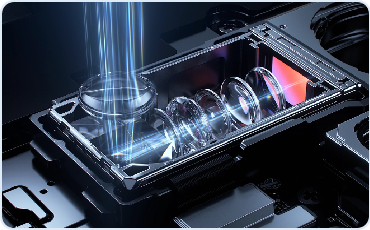
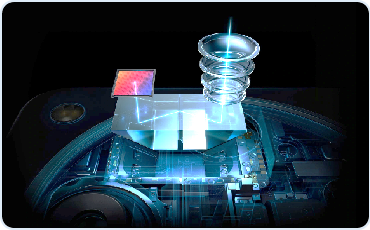
2. Consumer Electronics: Multi-group lenses are becoming increasingly common in flagship smartphones, but effective methods for precise measurement of single groups (such as G2 in a three-group system) remain lacking. Current industry-standard compromises often leave engineers in a dilemma:
"Benchmarking" Golden Samples: Finding a so-called "standard sample" from another group for paired testing. However, the surface shape and assembly accuracy of Golden samples are not absolutely guaranteed. Using one "uncertainty" to measure another "uncertainty" often yields unsatisfactory results.
Blind Testing with Overall AA Imaging: Abandoning process inspection and directly proceeding to the post-assembly active alignment (AA) stage. This "blind box" approach means that individual surface shape deviations or eccentricities can only be detected during final imaging, resulting in a complete loss of leverage for yield improvement and quality control during the process. Lacking effective inspection tools, yield optimization becomes impossible.
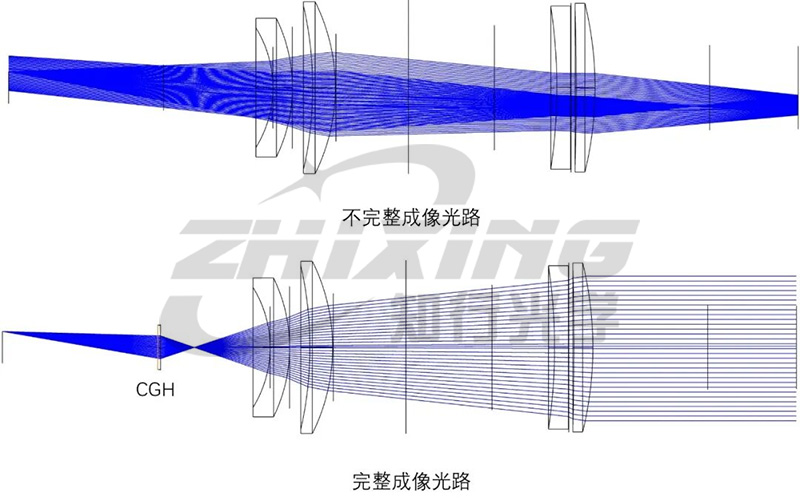
In fact, we don't need to actually manufacture the subsequent physical lenses before testing. Utilizing the powerful phase reconstruction capabilities of CGH (Computational Hologram), we can achieve zero-position detection closed-loop at the physical level for incomplete optical paths.
I. Reverse Reconstruction: Phase Compensation for Missing Optical Paths
Since the lens group under test itself lacks imaging capabilities, essentially because there is a phase difference in the optical path that needs to be compensated for. In the design software, we extract the "missing" part of the optical path within the complete system and precisely mathematically quantify the wavefront transformation and aberration cancellation effects it should produce.
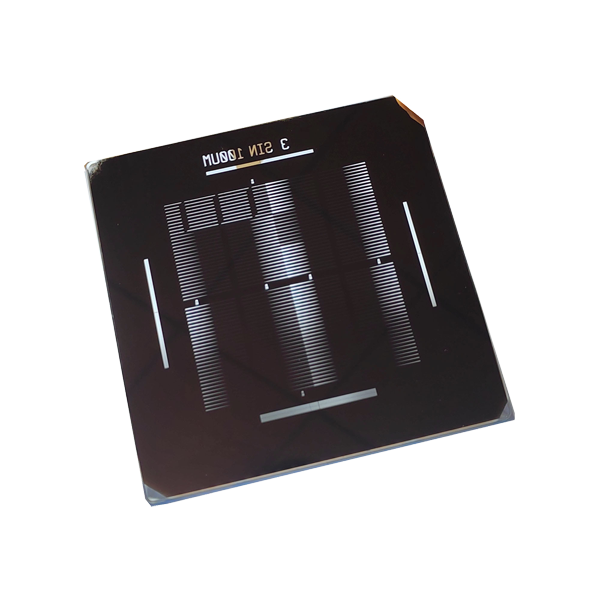
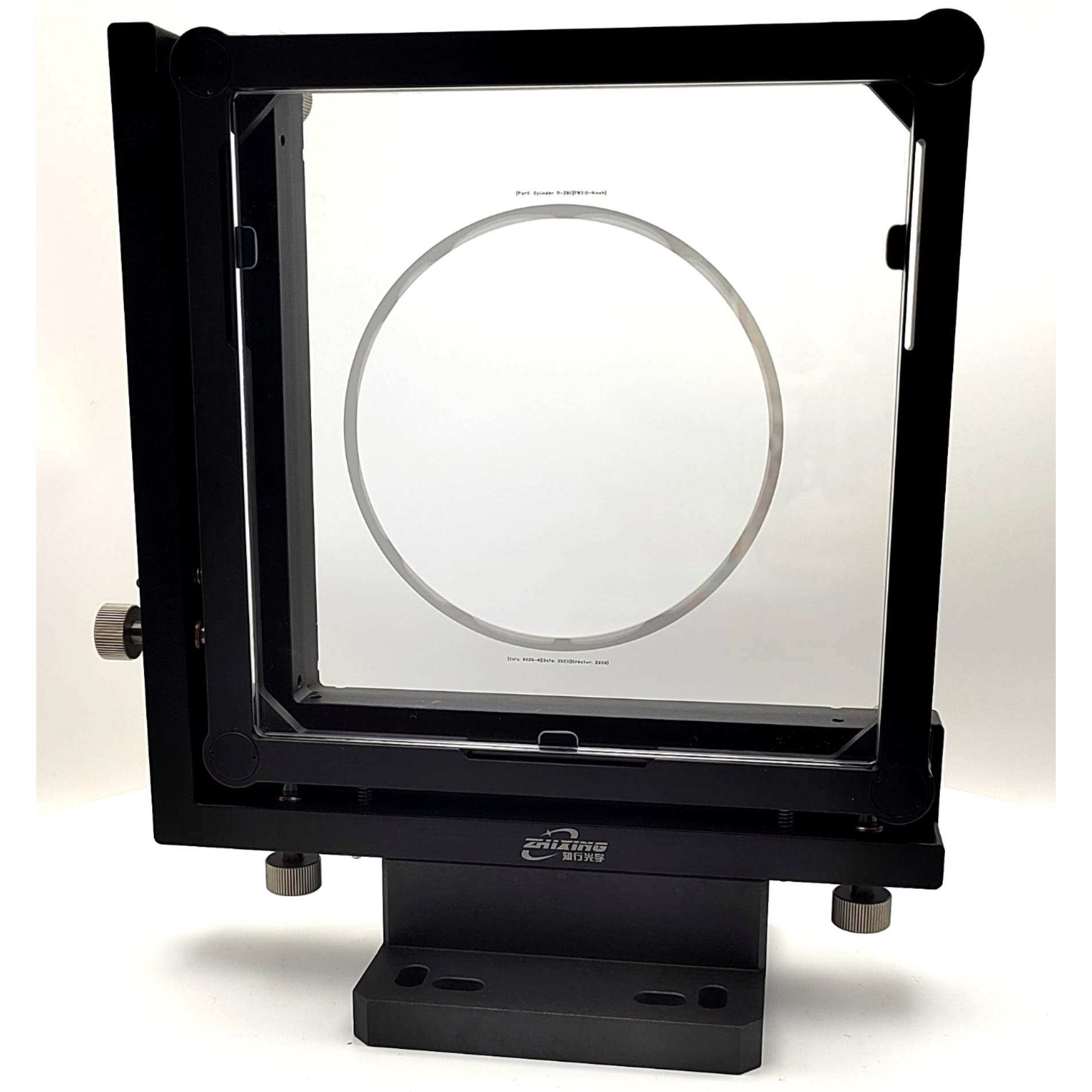
These phase distributions are ultimately encoded and etched onto the micro/nano structure of the CGH. During testing, the CGH... It acts as a "virtual correction mirror group," precisely compensating for system aberrations through diffraction effects and restoring the distorted wavefront to a standard wavefront in real time.
II. Engineering Advantages: The Measurement Revolution Brought by CGH
Reconstructing the inspection closed loop using CGH is essentially a logical optimization of traditional assembly and adjustment processes:
1. Simplified Optical Path, Avoiding Error Accumulation: Compared to building bulky physical compensation lens assemblies, a single, thin CGH can achieve an equivalent replacement, reducing the accumulation of component surface shape errors and alignment errors at the source.
2. Integrated Reference, Locking Spatial Degrees of Freedom: CGH can integrate alignment holograms in non-working areas. By projecting virtual "cat's eye points" or "crosshairs," the six degrees of freedom (X, Y, Z and three rotation angles) of the lens assembly in space can be directly locked, achieving precise positioning.
3. In-situ Evaluation, Reducing Assembly Risk: During the assembly and adjustment stage of a subsystem, its performance in the complete system can be previewed in advance using CGH. If abnormal fringing is found, it can be corrected directly in the current process, avoiding the accumulation of errors until the final assembly stage, greatly improving the first-pass yield.
III. Conclusion: Breaking Through Inspection Blind Spots, Making Yield "Visible and Controllable" in the Assembly and Adjustment Stage
The challenge of precision optical manufacturing often lies not in the perfection of individual components, but in achieving convergence of system-level indicators under extremely stringent engineering constraints.
The normalization of measurements of "incomplete systems" means that traditional inspection methods have reached their limits. The core value of CGH is not simply physical completion, but rather, through digital phase reconstruction, establishing a high-confidence measurement benchmark for the previously "blind" intermediate process. It transforms invisible wavefront deviations into quantifiable and traceable compensation data, thereby transforming assembly and adjustment from an experience-based science relying on "feel" to a precision engineering based on data closed loops.
Returning to engineering common sense, using deterministic benchmarks to address uncertainties in assembly and adjustment—this is the foundation of modern optical inspection.
About Zhixing Optics
Ningbo Zhixing Optics Technology Co., Ltd. focuses on high-precision computational holography (CGH) inspection solutions, dedicated to solving the core pain points in the measurement of aspherical and freeform surfaces. We provide a one-stop service from CGH design and manufacturing to high-precision optomechanical assembly and adjustment, providing a robust "testing benchmark" for precision manufacturing.